
Dr. M. Elizabeth Thorpe describes the way her understanding of rhetorical history shapes her faith.
Transcript
DDM [00:03] Hello and welcome to The Priest and the Prof. I am your host, the Rev. Deborah Duguid-May.
MET [00:09] And I’m Dr. M. Elizabeth Thorpe.
DDM [00:11] This podcast is a product of Trinity Episcopal Church in Greece, New York. I’m an Episcopal priest of 26 years, and Elizabeth has been a rhetoric professor since 2010. And so join us as we explore the intersections of faith, community, politics, philosophy, and action.
MET [00:38] I had this student once who had the greatest opening line to her presentations I have ever heard. It always made me laugh, but also feel really good about life because this young woman came from a really conservative background, and she had gone to a hardcore religious school, and she had a lot of glass-breaking moments in my class when I informed her what she had been taught by her pastor was not, in fact, true at all.
MET [01:04] But she was a genuinely good person, and she wanted to make people feel good in her presence. She cared about others. So at the beginning of every presentation, this hardcore religious kid would smile as big as she could and say, “Hello and welcome, guys, gals, and non-binary pals.” And it was like some tension melted in the room because we did, in fact, feel welcome.
MET [01:33] She didn’t know it, but she was a master rhetorician. What she inherently understood about audience, pathos and ethos, delivery, and messaging takes years to teach, which makes me think she had been absorbing it over her lifetime, which probably means she had grown up hearing some mighty good preachers.
MET [01:56] This young woman had come up in the tradition of the Black church, so things like audience, delivery, pathos, and ethos would have been incredibly important to a service. So she might never have taken a public speaking class, but had absorbed more about public speaking than half the people with communication degrees.
MET [02:17] Okay, so why am I telling you this? It’s a charming story, and it raises some interesting questions about whether one can actually teach another person to be a good public speaker. But what I really wanted you to notice was a kind of flashpoint. Over the last year and a half, I have talked to you about a lot of different kinds of rhetorics.
MET [02:40] We’ve covered classical theories, the postmodern, political rhetoric, legal rhetoric, religious rhetoric. I’ve taken you on a whirlwind tour. This is an interesting story because it covers so many of them. It is both political and religious. It is invitational and constitutive. It is Aristotelian and feminist.
MET [03:03] There’s just a lot. And I realize as I tell you this, I’ve taken you through your paces and gotten you to where you can recognize all of this. But I don’t know that I’ve ever made my fundamental connections for you. So today, if you’ll give me just a few minutes, I wanna take us back to the beginning.
MET [03:23] Carl and Reverend Deborah were kind enough to let me have the mic by myself this time because I wanted to take you on a journey that is specific to me, both as a person of faith and as an intellectual. So a bit of rhetorical history and theory. I know it’s just what you were thinking you needed today, but also you are here with me, so you had to know it was a possibility.
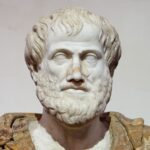
MET [03:49] Now, there are basically three roots to the rhetorical tree, the Sophist teachings, Aristotle’s theory, and Plato’s critique and elevation. I’m actually gonna start with Aristotle, not because he was first, but because he ended up being the most important. Plato won Christianity, but Aristotle won science and the Enlightenment.
MET [04:15] I mean, I guess we can argue about who was most important really, but I’m starting with Aristotle regardless, mostly because he ended up being the most important to rhetoric. Aristotle began with a few basic assumptions. One, the audience is rational. This is really important to understand. If you assume the audience is rational, it makes a difference in how you make your argument.
MET [04:42] It also lifts some of the burden on you to police yourself, if I’m being cynical, because a rational audience can sniff out problems. A rational audience can be persuaded by a good argument using evidence and reason. Aristotle also assumed that audiences were relatively universal. By that I mean he made sweeping generalizations about the elderly or the young or the rich or the whoever, and said, “These are their characteristics.
MET [05:13] Here’s how you appeal to them.” On the one hand, they were straight up stereotypes. On the other hand, we do the same thing with market research and voting demographics all the time. We just have numbers to go with our claims. I will note that any time I have presented Aristotle’s claims about people to modern undergrads, they have decided he got it about right.
MET [05:39] But this is also important to understand because his audience kind of was universal. It was all landowning male wealthy citizens of one city-state. I mean, if you only know one kind of person and they’re all the same, you’d probably jump to some conclusions too. Finally, Aristotle took these assumptions and said, “Rhetoric is discovering or using the best available means of persuasion in any given case.”
MET [06:10] This means given the audience, so they are old or they are rich, et cetera, what kind of things will they respond to? What is the best combination of proofs? There are inartistic proofs, which is just the stuff you don’t come up with, the stuff you bring into the argument, and there are artistic proofs.
MET [06:31] That’s what you bring to the argument. And this is why it matters that the audience is both, A, rational, so able to make considered decisions and can be persuaded, but also, B, young, so prone to rash decisions or whatever. The artistic proofs are appeals to logos, pathos, and ethos, and that just means how much you depend on appeals to logic, emotion, or your character.
MET [06:56] You are probably wondering at this point what on earth this has to do with me and my faith. I promise I will get there. We’re going the long way today. The second person who is worth talking about is Plato. Plato actually hated rhetoric. He hated rhetoric because he associated it with the Sophists, who I’ll talk about in a minute, who he believed to be dangerous and idolatrous. As far as Plato understood rhetoric, it was completely relativistic and could easily let the wrong people gain power.
MET [07:34] Plato was really certain of two things. There is a right and ultimate truth, and there are right kinds of people, and they should be in charge. For Plato, rhetoric shouldn’t be about persuasion. It should be about what he called the dialectic, a philosophical back and forth and an ongoing search for truth.
MET [07:57] Rhetoric should be a search for transcendence, not a bid for power. And along those lines, Plato wasn’t real big on democracy, whereas Aristotle’s and the Sophists’ versions of rhetoric went hand in hand with democracy. Plato believed what we need are philosopher kings, people of great knowledge, wisdom, and character who will take on the mantle of leadership and basically be a benevolent dictator.
MET [08:25] This is the difference I need you to understand. Plato is at the heart of both Christianity and fascism. Aristotle leads to the Enlightenment and colonialism. That just leaves the Sophists. Here’s what you gotta know. Everybody hates the Sophists. The Sophists were, depending on how you frame the story, itinerant teachers of rhetoric who went from town to town, sharing their knowledge in a radically democratic fashion, or flamboyant rabble-rousers who went to a town and took whoever’s money they could until they were thrown out of that town and went to the next.
MET [09:08] The Sophists were easy to recognize. As I said, they were flamboyant in their dress and hairstyle, and that in and of itself bothered the traditional, more civically-oriented teachers and politicians of the day. Once again, things have not changed. You’ve got the people in charge And you have the folks in edgy clothes and wild-colored hair demanding something different.
MET [09:33] Ecclesiastes 1:9 says there is nothing new under the sun. This is a reminder that in many ways that is very true. There will always be those with institutional power who hate upstarts who look and sound different with challenging ideas. What those challenging ideas were is of particular interest. For example, the Sophists had a very different approach to education than Aristotle, Plato, and all of the other rhetoric teachers in the Greek world.
MET [10:05] The established rhetoric professors, the ones who had their own institutions, were very selective about who they taught. They let in the sons of wealthy, established families who showed great promise in math, logic, rhetoric, and even physical prowess. The Sophist said, “Ha ha, not really,” and would teach anyone who had the cash.
MET [10:29] Now, a couple of things about that. It is at once both a hugely democratizing step in education, but also a sign that money still talks. It is democratizing in that there are no established hierarchy barriers. If you had the cash, you could get the education. Farmers, merchants, whoever. If you could save up the money, the Sophists would teach you. This means that the Sophists were offering anyone access to the education and power that were reserved for the propertied rich and powerful.
MET [11:06] So yeah, there were many reasons and excuses to hate the Sophists, but you had to figure that was one of the biggest. They were opening the doors of education to anyone. However, there were still barriers. Education was very expensive. You had to save up the money. Sometimes that could be close to a year or two’s worth of salary for some people.
MET [11:31] But if you had the money, they would teach you. Then there was what was taught. The Sophists taught about rhetoric, politics, and all the things that people like Aristotle, Isocrates, and Plato were teaching. But they also taught the equivalent of how to do your taxes. The Sophists taught things like how to make business decisions, how to comport yourself in public, and how to account for your money at the end of the day, as well as persuasion politics and democratic theory.
MET [12:05] So the democratization part of their education is vital to understand. Sophistic education wasn’t just about how to be a good senator or whatever. It was about how to be a successful and prominent citizen. Once again, you can see how this would upset those in power. The last thing they needed was for the commoners to have access to knowledge that would allow them to improve themselves and their lives in significant ways.
MET [12:36] Finally, one of the biggest reasons people like Plato hated the Sophists was their supposedly moral reasons. The Sophists had very different ideas on truth. For Sophists, truth was very much a matter of the moment. Truth was something that you created as a matter of context. Truth happened at a particular moment in that particular context at the right time in the right situation.
MET [13:05] You could imagine a guy like Plato, who believed in capital T truth, had a huge issue with the Sophists. But the Sophists believed and taught that truth was a creation of context. That, of course, made rhetoricians particularly powerful, because a person in that context could potentially be a truth maker.
MET [13:29] Now, it would appear that I have forgotten this is a podcast about issues of the faith, and I have taken it upon myself to lecture you about rhetorical history and theory. But actually, I want to tell you about how this comes together for me. Christianity borrows heavily from Plato. We get our notions of truth, hierarchy, and much of our philosophy from Plato.
MET [13:54] Our religion is surprisingly Greek and Roman for being based on an Aramaic Jew. And I don’t necessarily like what we got from Plato. Platonic thinking breeds exclusion. It creates environments where there’s not just insiders and outsiders, but blessed and cursed. And Aristotle’s clinical approach probably shaped Paul’s systematized and rhetorically constructed letters throughout the New Testament.
MET [14:23] Paul, being well-versed in Greek, probably knew all about these folks and had put their theories to good use. A study of the letters in the New Testament as documents and letters instead of theology reveals some pretty classically rhetorical artifacts. It is very easy to point to how Plato and Aristotle have affected Christianity.
MET [14:46] And because our faith is so vested in Plato and Aristotle, especially Plato, we assume that is right. There are ultimate truths, and there are ways to present your case. And I’m not here to contest any of that But I want to tell you for a minute about the Sophists and how I see their philosophy shaping my faith.
MET [15:09] For one, the Sophists opened up knowledge to everyone, or as much as anyone did in that day and time. This radical inclusion is incredibly important to my faith. I wouldn’t follow Christ if I did not believe he was open to everyone. Part of Christ’s revelatory approach to community was that he did not put up barriers.
MET [15:34] He was not a gatekeeper. There were no rules about who he would and would not share his message with or his table. I wouldn’t say Christ practiced radical democracy because I don’t think I would apply any statist theory to his work. But I do think he practiced radical inclusion in community.
MET [15:56] And of all of the rhetorical theorists of the classical age, it is the Sophists who got closest to that. In fact, Plato, who we borrowed most heavily from, was kind of the opposite of that. The Sophists were the ones who came closest to providing a picture of the kind of actions I see in the Gospels. And the fact that those in power hated them just lends credence to that.
MET [16:22] Secondly, the Sophists taught the kinds of things that affected people in their day-to-day lives. Plato and Aristotle were great if you were going to trial or were trying to get a body of legislation to pass a law. But the Sophists attended to your life, your mundane, everyday choices, as well as the grandiose.
MET [16:42] I see that in the Gospels as well. When Christ told a parable, it was often about someone relatable. In Luke fifteen, Christ tells the story of a woman who lost one coin and went searching for it. How many times do we hear about shepherds and their sheep? We also hear about rich men, but very often we hear as much about their servants as well.
MET [17:07] Christ’s lessons were about how to treat your neighbor more than how to relate to systems of power. Jesus wanted you to know how to function in the day to day as much as he did about how to function in the halls of power. Finally, and this is the clincher, the Sophists taught that truth was contingent.
MET [17:30] This is the stickler for a lot of people. If there is one thing we are certain of in Christianity, it is that there are certain truths that should not be questioned. And I’m not here to say whether that is or is not the case But I wanna talk about where I find God. All too often, God is not in the grand walls of a church.
MET [17:54] God is in small moments. God is in the time I spend with my husband and daughter. God is in those moments in the classroom when I know we’ve made genuine progress. God is when Carl, Deborah, and I finish up a podcast, and I know we’ve made a quality product that I think will help people. I’m not claiming I make God or truth, but I do find God and truth in the contextually defined moments of my life.
MET [18:23] It is one thing to say that God is everywhere all the time. It is quite another to know for a fact He is working in your life. Sometimes truth is found minute by minute. Sometimes God shows Himself in the most mundane circumstances. The Sophists taught that truth was a product of context. I am not telling you that God is a product of context.
MET [18:48] But in my life, God is found in those small moments that are defined by context of community, family, and even resistance. In that way, God is a God of context. For while He is always with me, I feel Him most when I am doing His work, and that is something I create. So what is the point of all this? For me, it is a matter of figuring out how we understand God.
MET [19:20] I’m a thinker. I understand the world as an intellectual project, so it matters to me what framework I view the world through. For some people, that isn’t a big deal, but for me it is. So when I consider this thing, rhetoric, that I have literally devoted decades of my life to, it matters how that colors other parts of my life.
MET [19:43] And what I have come to understand is that the connections are not always as clear as tradition would have us believe. Plato is not for me, though he is very much at the heart of Christianity. Aristotle doesn’t speak to me, though he probably did to Paul. But the Sophists, those folks who were accused of atheism, rabble-rousing, and disrupting the very fabric of society, that makes sense to me when it comes to the life of my faith.
MET [20:14] I can see where my mind and my spirit intersect there. So as I close today, I encourage you to think about a few things. How do you see the different parts of your world connecting? The Bible says we are supposed to love God with all our hearts, souls, and minds. How do you draw connections between all three?
MET [20:37] Where do you find your faith? Is it in big moments in church or in small moments in your life? What is meaningful to you? How do you live that out? Who is included in your faith? Are there barriers or is anyone invited? Consider these things as you move through the next two weeks. It’s your rhetoric homework
MET [21:16] Thank you for listening to the Priest and the Prof. Find us at our website, priestandprof.org. If you have any questions or concerns, feel free to contact us at podcast at priestandprof.org. Make sure to subscribe, and if you feel led, please leave a donation at priestandprof.org slash donate. That will help cover the costs of this podcast and support the ministries of Trinity Episcopal Church. Thank you, and we hope you have enjoyed our time together today.DDM [21:45] Music by Audionautix.com
Leave a Reply