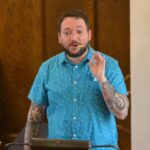

Dr. M. Elizabeth Thorpe welcomes the Rev. Dr. Dan Brockway from Brockport First Baptist for a discussion of the history of the Baptist denomination and the split between the Southern Baptist Convention and the American Baptist Churches, as well as some similarities to and differences from the Episcopal tradition.
Transcript
MET [00:02] Hello and welcome to The Priest and the Prof. I am your host, Dr. M. Elizabeth Thorpe. My producer. Carl and I would like to welcome you to a discussion about what it means to be a Christian in the 21st century. This podcast is a product of Trinity Episcopal Church in Greece, New York. I’ve been a rhetoric professor since 2010 and Carl has been working in church communications since 2022. And so join us as we explore the intersections of faith, community, politics, philosophy, and action.
MET [00:39] Hello and welcome. I have a guest today that I think is going to lead us in some great conversation. Joining me today is Pastor and Dr. Dan Brockway. He is the leader at First Baptist Church in Brockport, New York. Producer Carl and I have connections to this church as well as to Trinity, and I knew I wanted to have Dan on while we were between priests.
MET [01:16] So Dan can give you his own introduction and tell you a bit about himself, but what I want you to know about him is that he is a passionate, empathetic, and progressive leader of an incredibly welcoming church, and he is a very gifted and intentional preacher. Pastor Dan is a bit of a theologian after my own heart because he isn’t afraid to make things brainy or provocative.
MET [01:41] The first time I heard him make reference to Black feminist theorists in a sermon, I thought, “Yeah, okay, cool. I can follow along here.” So, Pastor Dan, will you tell us a bit about yourself, your background, and maybe a bit about your church? And do you want me to call you Dr. Brockway? Your academic credentials are worth acknowledging, and we will treat you like the expert you are
D_B [02:04] Well, first off, thank you. It’s a pleasure to be part of the show, and, you can call me Dan. I’m perfectly fine with being called Dan. It is okay. Technically it would be Reverend Doctor, but that just sounds too elitist, so I can’t, I can’t go there. But yeah, in terms of a little bit about myself, so I was born and raised in an American Baptist church.
D_B [02:21] I’ve been an American Baptist, my whole life. The church I grew up at, was in Bethlehem, Pennsylvania, near where I’m originally from. My mom served as the children’s ministry coordinator there for about 20 years, and she was the coordinator ’cause, you know, back then especially, women couldn’t be pastors was the assumption, so they called her a coordinator.
D_B [02:39] The first year seminary student who led the youth ministry was called youth pastor, but the woman who devoted 20 years of her life to the kids of that church was the coordinator. That’s probably a discussion for another day, though. So American Baptists are one of the more, I’d say, moderate to progressive branches of the Baptist tree.
D_B [02:57] There are plenty of ordained, fully recognized female pastors in our tradition, now. The ’90s I guess were a, a slightly different time. But as American Baptists, we pride ourselves on being, the Baptists that most other Baptists think are going to hell. That’s kind of who American Baptists are.
D_B [03:11] For a little background, so the American Baptists and the Southern Baptists split in the 1830s. I’ll give you one guess as to why. If you guessed slavery, you were right. Basically every Baptist church is its own independent entity, and back then, all the Baptist churches in the US would hold a convention every three years or so where they would send representatives and money to help fund missionary efforts around the world.
D_B [03:33] The Southern Baptists wanted to send slave owners to be missionaries to Africa, and the Baptists in the North said, “Hell no. Um, if you think it is okay to own Africans, you are not fit to minister or to be a missionary to Africa.” So the Northern Baptists pulled their funding from any missionaries who owned enslaved people, in the South, and the Southern Baptists broke off and formed their own convention, which to this day is known as the Southern Baptist Convention.
D_B [03:58] That’s their origin story. The largest Protestant denomination in the country, I believe, formed over slavery. And the Baptists in the North went on to become American Baptists, so that’s the origin of our denomination. As for me I went to seminary intending to teach theology. I thought I was gonna be a theology and church history professor.
D_B [04:16] Went on to do a PhD, in constructive theology out at Fuller Seminary in Pasadena, California. After about three years, though, as a full-time administrator at the seminary and a part-time adjunct professor, I wound up accepting a call to full-time ministry out here in Brockport. The church I serve at, Brockport First Baptist, I’ve been here for about going on nine years now.
D_B [04:36] They’re a wonderful, progressive, Christ-centered, queer-affirming American Baptist congregation, here in Brockport, which just so happens to be named after one of my ancestors. Fun fact.
MET [04:46] That is a fun fact. So Pastor Dan, I really appreciate you sharing some of your story with me, and I know for me, my Baptist background is a big part of who I am, even though I left the Southern Baptist Convention years ago, as we were just talking about the Southern Baptist Convention. I also know that the reasons I left are complicated and rooted in a lot of history that is both painful and somewhat surprising.
MET [05:15] From conversations we’ve had offline, I know you share some of my feelings about both the complexity of our Baptist roots and the implications of those. I’m gonna ask, if you don’t mind, if you would tell us a bit about some denominational history outside of just the SBC. A lot of our listeners are mainline Protestants and might not know some of the interesting background of Baptists, who are pretty different in some ways historically, politically, and theologically from others.
MET [05:44] So we’d love a church history lesson from you.
D_B [05:47] Absolutely. Happy to talk a little Baptist history. And yeah, Southern Baptists in addition to being the largest Protestant denomination in the country, I haven’t checked the numbers recently, but if memory serves, I believe the Southern Baptist Convention is larger than all other Baptist denominations, combined.
D_B [06:02] So they are definitely, in the majority. And a lot of the stereotypes about Baptists, you know, being very conservative, fundamentalist, a lot of that comes out of the SBC, the Southern Baptist Convention. But if you know a bit about Baptist history, it looks a lot different from how Southern Baptists conduct things today.
D_B [06:19] So we got our start as Baptists in the English Reformation. Across continental Europe, most places, most countries, the churches during the Protestant Reformation chose a side. You know, if you were in Germany, you were Lutheran.
D_B [06:31] If you were in, you know, Northern Europe or, or Switzerland, you were a Presbyterian. Basically, if you were anywhere in Europe that hadn’t been fully conquered by the Romans back in the day, you were a Protestant. And then if you were in the heart of the old Roman Empire, you know, Italy, Spain, France, you were Catholic, and it was kind of very clean cut.
D_B [06:47] You can actually draw a little border between the Protestant areas and the Catholic areas during the Reformation. However, things, as they often do, went a little differently in England. Henry VIII, who started out as a proud Catholic and actually persecuted Protestants early on in his reign, decided he wanted a divorce from his first wife, Catherine of Spain.
D_B [07:07] The Pope said no, and Henry, not wanting to be bossed around by the Bishop of Rome, decided to form his own church. He put the English Protestants, who were pushing to reform the church for years, he put them in charge, and the Church of England was born. Fast-forward a couple decades, Henry dies, and his daughter Mary comes to the throne. You might know her as Bloody Mary or Queen Mary. She, imprisons, locks up, and executes, most of the Protestant church leaders in England, and she declares that England is Catholic again.
D_B [07:36] But then after, a few years, Mary dies. Her sister Elizabeth comes to the throne, and of course, Elizabeth is Protestant. So now England is Protestant again. So basically in England, while the rest of Europe was kinda neatly choosing sides, England went from Catholic to Protestant, back to Catholic, and then to Protestant all over the course of about 30 years based on who the monarch was.
D_B [07:56] And with each of those transitions, there was a lot of blood, a lot of persecution of the losing side. This also, though, made England a bit of an incubator of sorts for all kinds of ideas about church and state, Protestantism and Catholicism, what your particular brand of Christianity would look like. You had the Church of England, which in the end landed on a sort of middle path between Catholicism and Protestantism.
D_B [08:19] Then you had the Puritans, who I, think a lot of us are probably familiar with. The Puritans thought that the Protestants and Catholics were both out to lunch, and they set out to purify the Church. And then you also had a number of groups, like Congregationalists and Separatists who broke away from both churches, Protestant and Catholic, and started doing their own thing.
D_B [08:37] And this is really where the Baptists came in. The earliest Baptists were basically a bunch of English Separatists who had the radical idea that what church we go to shouldn’t be determined by the monarch. They rejected their infant baptisms into, you know, Henry’s church or Mary’s church or Elizabeth’s church.
D_B [08:55] They went down to the river, and they re-baptized themselves as adults, full immersion, dunking basically, into a church that was fully separate from state control Of course, the authorities saw this as an act of treason. When you renounced your baptism into King Henry’s church, you were essentially renouncing your allegiance to King Henry and the throne.
D_B [09:15] And this led to persecution. At one point in England, the punishment for being re-baptized as an adult was execution by drowning. If they caught you doing this, you would be tied up and thrown into the river. This in turn led the Baptists to venture out to the New World in search of religious liberty, and that, that kinda helps to transition, or that, that kind of brings us to the American front.
D_B [09:36] The first Baptist church in America, literally, was founded by Roger Williams. A little bit about Williams. He was a Puritan pastor who converted to Baptist and then was exiled from the Massachusetts Bay Colony in the dead of winter. He was only saved when some of the Native Americans nearby gave him shelter and food for the winter.
D_B [09:54] But he would go on to be the founding governor of Rhode Island, the first colony that recognized full religious liberty for all. And Roger Williams was also the founding pastor of the first Baptist church in America, which was in Providence, Rhode Island. It’s still there. I actually took a little pilgrimage to it, about a year ago.
D_B [10:09] A beautiful church. Roger Williams would go on to advocate for peaceful relations with the Native Americans. He also advocated for the abolition of slavery in all 13 colonies, and this was in the mid-1600s, so he was, he was a man well ahead of his time. And he’s also believed to be the first person to ever put the phrase “separation of church and state” in writing. In a letter, he wrote about the need for a hedge of separation between the church and the state to protect the church from the state and to protect the state from the church. So a little fun fact about Roger Williams. But if you look at that history, that tradition, it looks a little different from, I think, what a lot of people think of when they hear Baptists today.
D_B [10:49] You know, some of the things I love about my tradition, I love that the separation of church and state has Baptist roots, and this idea that separation of church and state isn’t just about the church withdrawing from the world or staying silent on politics, but you’re basically separate so that you can be that prophetic witness.
D_B [11:07] I love the anti-monarchical roots of our tradition. I love how much the Baptists are rooted into the civil rights tradition, especially, in the American Baptist Church and among African American Baptist churches. I love our embrace of democratic church governance. Baptist churches are very bottom-up.
D_B [11:23] The congregation makes decisions, runs the church. And I also love our emphasis on personal convictions. You know, Baptists are non-creedal, in part because of that early history of persecution. We don’t believe on enforcing creeds on people historically. That, the creeds are very much not a Baptist thing.
D_B [11:41] We also practice believer’s baptism, this idea that, a person decides when they want to become a disciple of Jesus, and again, that’s all very much rooted in our history. There’s also, though, some things that I low-key hate about being Baptist. I don’t love our reputation. I don’t love the way we tend to strip the magic and mystery out of absolutely everything.
D_B [12:01] We kinda lead with our heads, with our brains, more so than with heart or with mystery. And it can also be a little frustrating, when all the power lies at the local church level. The denomination as a whole can’t really take a stance on much of anything. So what you find among American Baptists and National Baptists and some of the other smaller Baptist denominations is a lot of individual congregations that are very active, in their community advocating for important causes, but the denomination as a whole often can’t really make a statement on anything because it’s not top-down, it’s bottom-up.
D_B [12:33] And sometimes our emphasis on the personal, individual side of faith, actually deciding what church you’re gonna go to, to root back to our history, sometimes that gets a little too extreme. And it leads to a real downplaying of the communal and, the importance of the richness of our tradition and the being part of the community of faith.
MET [12:53] The love-hate association with the Baptist tradition speaks volumes to me. There were definitely things I liked about being a Baptist, but actually some of the things I liked about being a Baptist have become some of the things I am most skeptical of now. For example, when I was young, like you, I really believed in the emphasis on personal convictions.
MET [13:19] I liked the idea that it was our personal relationship with Jesus that made a difference in our faith and our salvation. I’ve actually come to rethink that So since 2003, I have largely gone to Lutheran and Episcopalian churches.
MET [13:36] There are reasons for that, but we don’t need to get into it now. But one of the things that I have kind of adjusted my thinking on is the idea of an individual faith. Mainstream Protestant churches, or at least many of them, don’t have the focus on individual salvation the way Baptists do. Salvation isn’t between you, the individual, and God.
MET [13:56] Salvation is communal in a sense. God so loved the world. Jesus came to save the world, not me. Now, there are things this produces that I’m not a huge fan of. I never got into liturgy all that much. I was, thought it was a little bit lifeless. But the idea that we are a faith community and my faith depends on my church as much as it depends on me has had a profound effect on the way I see the world.
MET [14:24] For one, I have rethought the whole Baptist pray the prayer thing. When I was little, it was impressed upon me very clearly that I was not saved unless I verbally and out loud prayed to ask Jesus into my heart. I think that’s weird. It means my salvation is dependent on something I do. I am necessary for my own salvation in that scenario, and that doesn’t seem to me to make sense based on what I have gathered from my understanding of scripture and theology.
MET [15:01] God saves. Christ saves. I do not. My role in salvation is that I need it, not that I do it. And the Baptist, or at least the Southern Baptist requirement, is that I take the lead in the process, and that strikes me as a bit, I mean, honestly egotistical, maybe narcissistic. And the other thing that has led me away from the kind of individualistic thinking about faith is thinking about impact.
MET [15:29] As I’ve gotten older, I’ve come to realize that impact is more important than intent, and the focus on individualism in evangelicalism at large has led to some really dark places. Baptists and many evangelicals believe that a personal faith is necessary, and that emphasis on the individual has wide-ranging and long rippling effects.
MET [15:51] When religious people focus on the individual instead of the communal, the way they see the world changes. A faith that is about the person encourages a worldview that is about the person, and this is, I believe, the origin of much of the conservative liberal market love that runs rampant in evangelical circles.
MET [16:11] And that, I think, is so antithetical to the actual gospel. When one’s faith is focused on a personal relationship, a person’s own actions, why should one concern oneself with the community? And I feel like this attitude slips into perspectives on the economy, politics, service, education, and everything. If a person’s most personal and important relationship has no obligations outside of oneself, why would you think you would do anything else in any other setting?
MET [16:44] And evangelicals tend to see everything in an individual as sacrosanct kind of way in terms of money, politics, civil rights, et cetera, and that’s not how I understand either testament. Christ definitely told us parables about the one woman looking for her lost coin. That is true. But his directions were to pay attention to the needs of the vulnerable, the margins of the community, not our individual status with God.
D_B [17:13] Hmm. No, that’s excellent. I feel you on all of the above. I actually think your critique of the Baptist emphasis on personal salvation and choosing our place in the faith and the way we basically task individuals with saving themselves or doing their own salvation, it’s a really good critique.
D_B [17:31] Thinking about it, I think the early Baptists were pushing back against the idea that it’s a king or a monarch who does the saving, who, you know, who says what church you go to. And rather than getting back to, “No, it’s God who saves,” it’s like, “No, it’s us. We choose. We say the prayer or we get baptized.
D_B [17:49] You know, we make that statement.” So no, I feel you on all of the above. I would… I’d wanna differentiate Baptists from evangelicals, a little bit. Evangelicals at this point, I think, are really more of a voting bloc than a religious affiliation. And the Baptist tradition is broader than that.
D_B [18:05] But a lot of the issues you’re landing on, I think, come even more out of the, the Great Awakening and some of the history behind evangelical revivalism. Basically, this push 150 years ago, 200 years ago now maybe, to turn faith into a sales pitch. It’s like selling a vacuum.
D_B [18:21] You know, “Do you have dirty floors at home? We’ve got a new vacuum that can fix it.” The evangelical revivalist version of that is, “Do you know where you’re going when you die? Well, we’ve got a savior for you.” You know, there’s very much that sort of thing. I would connect a lot of that more to the Great Awakening and evangelicalism.
D_B [18:35] However, Baptists were absolutely a part of that. We were very much knee-deep, in that movement and unmistakably shaped by it. I think one of the big problems with Baptists in the United States at least, when I think about how did this forward-thinking, populist religious movement come to be sort of what it’s known for nowadays?
D_B [18:58] I think our biggest problem is that we won. We got our way. Baptists in the United States really got everything we were asking for and more. We got separation of church and state. We got the freedom to, you know, read and interpret the Bible and the faith for ourselves. We got the freedom to self-govern our individual churches, and in many respects, Baptists and our way of doing church kinda became the majority.
D_B [19:18] You go to any non-denominational evangelical church, megachurch, they’re basically practicing Baptist polity and church governance. It’s that same sorta thing. You go church shopping. You choose what church you’re gonna go to. Not so much because we’re rebelling against a monarch anymore, but because we’re part of a capitalist religious marketplace.
D_B [19:35] We got so comfortable in America, that Baptists really cozied up with power. You especially see this in the South. That urge to be independent from the state sort of devolved into this desire to control the state, to try to use state power to advance our own agenda, and in many respects, again, I think especially in the American South, Baptists became the de facto state church, which, I mean, irony of ironies there But I do think if you’re interested in seeing a different kind of Baptist, I think the place to look is Baptist churches that are operating in the minority, in the margins, separate from state power.
D_B [20:11] I think of African American Baptist churches, who have been involved in the civil rights movement for decades. Those churches that are still pushing for voting rights, organizing Black Lives Matter protests. I think about immigrant Baptist churches. Here in Rochester, we actually have a number of Burmese Baptist congregations filled with refugees who just recently lost their temporary protected status. But there’s also Spanish-speaking Baptist congregations, Chinese immigrant Baptist, congregations who are increasingly being targeted by the state and, fighting to protect their communities from ICE deportations. And I also think about progressive Baptist churches, small progressive Baptist churches like my own here in Brockport, that are trying to reclaim the best parts of our history, while being a safe and inclusive place for everyone, for queer folks, for trans folks, for people with church hurt, really trying to harken back to what I think made Baptists so special to begin with and to open the faith up to more and more people.
MET [21:10] I think that’s a really reasonable and thought-provoking response, and what I want most out of this is to give our listeners something to think about in terms of community. Yes, I like that Episcopalians and Lutherans focus on communal salvation, but we have to acknowledge that community is larger than denomination.
MET [21:34] Baptists don’t do the Apostles’ Creed all that much. You were talking about how you’re not a creedal denomination. But in that creed, there is a call for all of us to come together as one holy catholic apostolic church, and not like Roman Catholic, but catholic as in universal. So it is important to have conversations like this because we are all, regardless of the trappings of our denominations, all in this together.
MET [22:03] Our jobs, be it as they are espoused from the Sermon on the Mount or the Great Commission, are pretty much the same. So Pastor Dan, Dr. Brockway, he’s not that kind of Baptist, but what is important is that he is that kind of brother in Christ. The differences are important in that they speak to the specific ways in which we speak to and understand God, but the similarities are more important because that is who we are.
MET [22:21] Thank you for listening to the Priest and the Prof. Find us at our website, https://priestandprof.org. If you have any questions or concerns, feel free to contact us at podcast@priestandprof.org. Make sure to subscribe, and if you feel led, please leave a donation at https://priestandprof.org/donate/. That will help cover the costs of this podcast and support the ministries of Trinity Episcopal Church. Thank you, and we hope you have enjoyed our time together today.
Music by audionautix.com
Leave a Reply