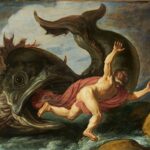

Dr. M. Elizabeth Thorpe and Producer Carl Thorpe talk about the story of Jonah and what we should take away from it.
Transcript
MET [00:02] Hello and welcome to The Priest and the Prof. I am your host, Dr. M. Elizabeth Thorpe. My producer. Carl and I would like to welcome you to a discussion about what it means to be a Christian in the 21st century. This podcast is a product of Trinity Episcopal Church in Greece, New York. I’ve been a rhetoric professor since 2010 and Carl has been working in church communications since 2022. And so join us as we explore the intersections of faith, community, politics, philosophy, and action.
CRT [00:38] Producer Carl here. This episode has been a bit of a challenge to get out. This week, Elizabeth is traveling for a conference, and I’ve got a terrible cold. So please bear with us as we do a shorter episode this time.
CRT [00:53] On October 16th, twenty twenty-six, a movie called Whale Fall was released in the United States. This movie, based on a twenty twenty-three book of the same name, tells the story of a young man who is swallowed by a sperm whale while searching for the remains of his estranged father. Of course, there’s also the classic story of Geppetto in Pinocchio being swallowed by a terrible dogfish.
CRT [01:16] (It’s a whale in the nineteen forty Disney film.) If you haven’t already guessed, we are talking about Jonah today. Most of us probably remember the story of Jonah from when we were kids. It’s a big children’s Bible story. Basically, Jonah is told by God to go to the city of Nineveh and warn them that their wickedness will bring about their destruction.
CRT [01:38] Jonah doesn’t wanna do that, so he gets on a boat to flee. The boat is beset by a massive storm, and the sailors, who are pagans, end up throwing Jonah overboard at his own request to calm the sea. When that works, they give praise to the Lord. And rather than let Jonah drown, God sends a fish to swallow him whole.
CRT [02:01] While in the belly of the fish, Jonah repents and is vomited out onto the shore. He finally ends up going to Nineveh and warning them of their impending destruction. In response, the people of Nineveh repent and are spared. Now, here’s a part that I didn’t really get when I was a kid. Jonah is so angry that the people were spared that he demands that God let him die.
CRT [02:28] The book ends with God chastising Jonah for wanting the city to burn using a quick-growing plant and an appointed worm to illustrate the reason why he spared them
CRT [02:39] This doesn’t really seem like the other prophets of the Bible, does it? I mean, there’s barely even any prophecy made by Jonah. He tells the people, “Forty days more and Nineveh shall be overthrown.” That’s it. That’s his whole prophecy to the people. The other prophets go on for pages upon pages. He gets one sentence, and that’s all it takes.
CRT [03:04] If the rest of the prophets got such quick results, the Bible would be a whole lot shorter. And then there’s Jonah’s whole dramatic demand to die. He tells God, “This is why I tried to flee. I knew you would be compassionate and forgive Nineveh. Since you did, just let me die.” He goes out of the city, he sits down, and waits to see what happens.
CRT [03:28] In response, God makes a plant grow and provide him shelter, making Jonah a little happier, a little less angsty. And then God sends a worm to kill the plant, which makes Jonah angry again, and he once again asks God to let him die Now, Jonah isn’t unique in asking God to die. We see Moses and Elijah both ask God to let them die.
CRT [03:53] But the difference there is that they wanna die because they are exhausted and discouraged by what they see as their own failings and the immense task that they undertook. Elijah is exhausted from his victory over the prophets of Baal and fleeing a would-be murderer in Jezebel. Moses was worn down by the long trek through the desert after leading the Israelites, who were often ungrateful, out of Egypt.
CRT [04:18] Jonah, on the other hand, wants to die because he was too successful, and it was too easy because God is too compassionate. Now, to be fair, the city of Nineveh was part of the Assyrian kingdom, and the Assyrians were bad, really bad, cut off body parts of their captives and hang them on the city walls bad.
CRT [04:38] So maybe Jonah has a reason to want to see them destroyed, but his God doesn’t seek vengeance on them, at least not right now. So then we get the whole plant thing. It’s pretty weird. He sits outside of the city and seethes. God responds by making a large plant grow to give him shade and comfort. Just as Jonah’s starting to feel better, God appoints a worm to kill it, eliminating the shade and making him miserable again.
CRT [05:02] When he repeats his demand to die, God responds by calling him out for being angry about the plant. God tells him that he was happy about the plant growing and then angry about it dying despite the fact that he didn’t have anything to do with it. He didn’t plant it. He didn’t water it. He did no labor, but he wanted to claim the benefit of the plant.
CRT [05:23] And then when the plant died, again, not because of anything he did, he got angry. God points out that unlike Jonah and the plant, God did labor to create the people of Nineveh. Since that is the case, wouldn’t God have even more cause to be upset if they were destroyed? So what do we make of the Book of Jonah?
CRT [05:42] We’re told that it’s a book of prophecy, but it doesn’t read like one. Elizabeth, can you tell us what a book of prophecy would normally look like?
MET [05:51] Many books of prophecy follow a same general pattern. It’s so predictable that there’s even a rhetorical genre named after it. I’ve told you about it before, but I’m returning to it again. It’s the Jeremiad. The Jeremiad is specifically named after the patterns in the Book of Jeremiah, but many of the prophets in the Old Testament follow this general pattern, and the pattern has been successful enough that we’ve kept with it This is actually an important point of rhetorical analysis.
MET [06:24] You may have had an English teacher or even a speech teacher at some point say, “Oh, and here you can see the speaker or writer uses an incredible appeal to logos.” And as a student, you rolled your eyes because in no way did you think that the writer or speaker in question sat down and thought, “Ah, yes, here I will appeal to logic.”
MET [06:46] Well, you’re right. They most likely didn’t. So why do we ask you to be aware of that kind of thing if it wasn’t even intentional? Because that’s not the point. The point is that we do what works even without thinking about it. And people who pay attention to these things, and people who know how to speak and write, know that for the last so many thousand years, it has been effective to make a logical appeal in certain contexts.
MET [07:18] A good speaker, who usually became a good speaker by listening to other good speakers, recognizes that now is the time to make a rational appeal. Does she sit down and say, “Ah, yes, logos time”? No, but she intuitively knows rationality is called for. So we, as analysts later, can hear her speaking and say, “Wow, that was particularly effective.
MET [07:44] Let’s talk about what made it effective.” Well, this rational appeal that was in this particular spot, for one thing, made it effective. And we note that as an appeal to logos, and we do so for two reasons. So we know how and why we are being persuaded because that makes us better informed citizens, and because learning how other people are good speakers and writers makes us better speakers and writers if we are willing to make the connections.
MET [08:16] So a genre, which is what a jeremiad is, is a specific kind of speech, and a genre tells us something particular too. A genre is a response to a specific set of circumstances. There is something that is happening out there in the real world that calls for a particular kind of reply, and how well you hit those marks determines your rhetorical success.
MET [08:43] Think of it this way. On the first day of class, my students expect me to come in, introduce myself, tell them what the class is about, and go over the syllabus If I came in and did interpretive dance, it would be a huge departure from the expectations and maybe a real turnoff. I’d probably lose some students.
MET [09:05] That’s because we are really invested in rhetorical expectations. When those aren’t met, we get a bit testy, unless we’re working with a really skilled rhetor who can play with those expectations in such a way as to surprise and amuse or enlighten us.
CRT [09:24] The Book of Jonah doesn’t follow those rules, does it?
MET [09:27] Jonah is the story of a prophet, but it is not a generic one.
CRT [09:33] Some people say that it’s possibly more of a satire of a prophetic book
MET [09:39] it is specifically not a jeremiad. A jeremiad is a rhetorical genre characterized by a long, mournful complaint or lamentation that bitterly decries the moral decline of a society and warns of its imminent downfall. And whether delivered from a seventeenth-century Puritan pulpit or written as a modern political column, a classic jeremiad follows a distinct three-part rhetorical structure.
MET [10:09] One, establishing a foundational idealized covenant or high moral code. Two, cataloging and bitterly lamenting the community’s current moral decay, sins, and unfaithfulness to that standard. Three, warning of the doom or societal collapse that will follow if behaviors do not change, while simultaneously holding out hope for a glorious restoration if the community repents and reforms.
MET [10:38] Jonah kind of does those things, but the Book of Jonah is not his prophecy. The Book of Jonah is about his travails as he tries to make his prophecy. In Jeremiah and other prophetic books, the record is of what the prophet is preaching to fallen Israel. Jonah is about the fallen prophet. It completely turns the genre of a prophetic book on its head.
CRT [11:07] Jonah is, from what we see here, kind of a bad prophet. I mean, he’s good at his job. The Ninevites turn away from their ways. The sailors on the boat that he fled on praise the Lord. But he never seemed to have that as a goal. He seemed to want to watch the world burn. Jonah wasn’t hoping for conversion or salvation.
CRT [11:28] He was hoping for damnation. That’s hardly what you want from someone who is supposed to be the mouthpiece of God. Maybe that’s why Jonah has such a hard time.
MET [11:37] Yeah, he eventually goes where he’s supposed to and says what he’s meant to, but never with a just heart.
MET [11:44] In Jonah, it’s not the people who have fallen, but Jonah, and it is because he follows God’s will with an unrighteous spirit. Jonah does not love those that he preaches to. In truth, he wishes them harm, and so his prophecy doubles back on him. What then can we say about Jonah? Does he really have a lot to teach us, or is he just a literary conceit?
MET [12:12] I think Jonah can tell us a lot. Because Jonah does all the right things, he follows the rules, but God is unhappy with him. This should tell us something about our relationship with God as well. You can say the right things, go to the right church, even go on the right mission trips. You can pay your tithes, even volunteer.
MET [12:37] But if you do so out of a desire just to fulfill an obligation and not out of a desire to love your human family or serve God and His desire to take care of your human family, you have not done God’s will. Serving God is not about checking boxes or saying the right words. Fulfilling God’s will or even God’s prophecy is not about just showing up in a designated spot and preaching. It is about being a beacon of love. Jonah wasn’t willing to do that, and he got all dramatic about it, and the Bible tells us God appointed a worm to go and make life miserable for him. Now, I don’t think God is going to set bugs on you.
MET [13:26] This is why I think the book needs to be thought of in a literary way. But you won’t get what you think you will. God’s not going to reward you with bounteous blessings because you followed the rules. Blessings come from blessing others. Jonah didn’t get that. So we encourage you to start thinking outside of the rules of your faith and consider the relationships of your faith.
MET [13:55] Who are you called to bless, and how? Who should you be bringing God’s love to? Have you been resistant? Why? These are questions I have to ask myself. I won’t lie, and I don’t always like the answers.
MET [14:55] Thank you for listening to the Priest and the Prof. Find us at our website, https://priestandprof.org. If you have any questions or concerns, feel free to contact us at podcast@priestandprof.org. Make sure to subscribe, and if you feel led, please leave a donation at https://priestandprof.org/donate/. That will help cover the costs of this podcast and support the ministries of Trinity Episcopal Church. Thank you, and we hope you have enjoyed our time together today. Music by audionautix.com
Leave a Reply